The Best Chess Endgame Trainers in 2026
Updated
The best chess endgame trainers do not all train the same thing. Some teach the textbook positions as short lessons, some rate you on problems taken from real games, some drill a book with spaced repetition. This page compares four of them by what each is best at, so you can pick the one that fits the gap in your endgames.
Disclosure: this page is published by ChessEndings, which is itself an endgame trainer. We do not rank ourselves below; the four tools compared are not ours, and each description sticks to what the tool’s own site says. Weigh our perspective accordingly.
The four tools
1. Lichess Practice: the free starting point
Lichess Practice is a free set of interactive lessons. Its endgame chapters cover the piece checkmates (including the knight and bishop mate), pawn endings (key squares, opposition, the seventh-rank rook pawn against a queen) and rook endings (Lucena and Philidor, then intermediate and practical rook endings). It costs nothing and asks for no account to start, which makes it the natural first stop.
2. ChessTempo: rated problems from real games
ChessTempo runs an endgame trainer built on positions taken from real games, more than 17,000 of them, with an endgame rating that tracks your level. Positions of three to seven pieces are checked against a tablebase. It suits players who want volume and a number to measure progress by, more than an explanation of each method.
3. Chessable: a book, drilled with spaced repetition
Chessable turns books into courses reviewed with its spaced-repetition trainer (MoveTrainer). The endgame flagship is 100 Endgames You Must Know by GM Jesús de la Villa, the positions that come up most in practice, worked through one by one. You memorize the book’s lines; each course is bought separately.
4. Endgame Trainer: curated positions, draws included
Endgame Trainer focuses on endgames with few pieces: more than 6,000 positions picked by hand (no computer-generated puzzles), about a quarter of them draws, so you practice holding a position as well as winning it. It runs in the browser on a subscription.
Side-by-side comparison
| Tool | Best for | Platforms | Pricing |
|---|---|---|---|
| Lichess | Free interactive lessons: basic mates, pawn and rook endings | Web | Free, donation-supported |
| ChessTempo | Rated endgame problems from real games, tablebase-checked | Web | Free account; paid memberships |
| Chessable | Book courses with spaced repetition (100 Endgames You Must Know) | Web, iOS, Android | Per course |
| Endgame Trainer | 6000+ hand-picked positions, draws included | Web | Subscription |
Where this site fits
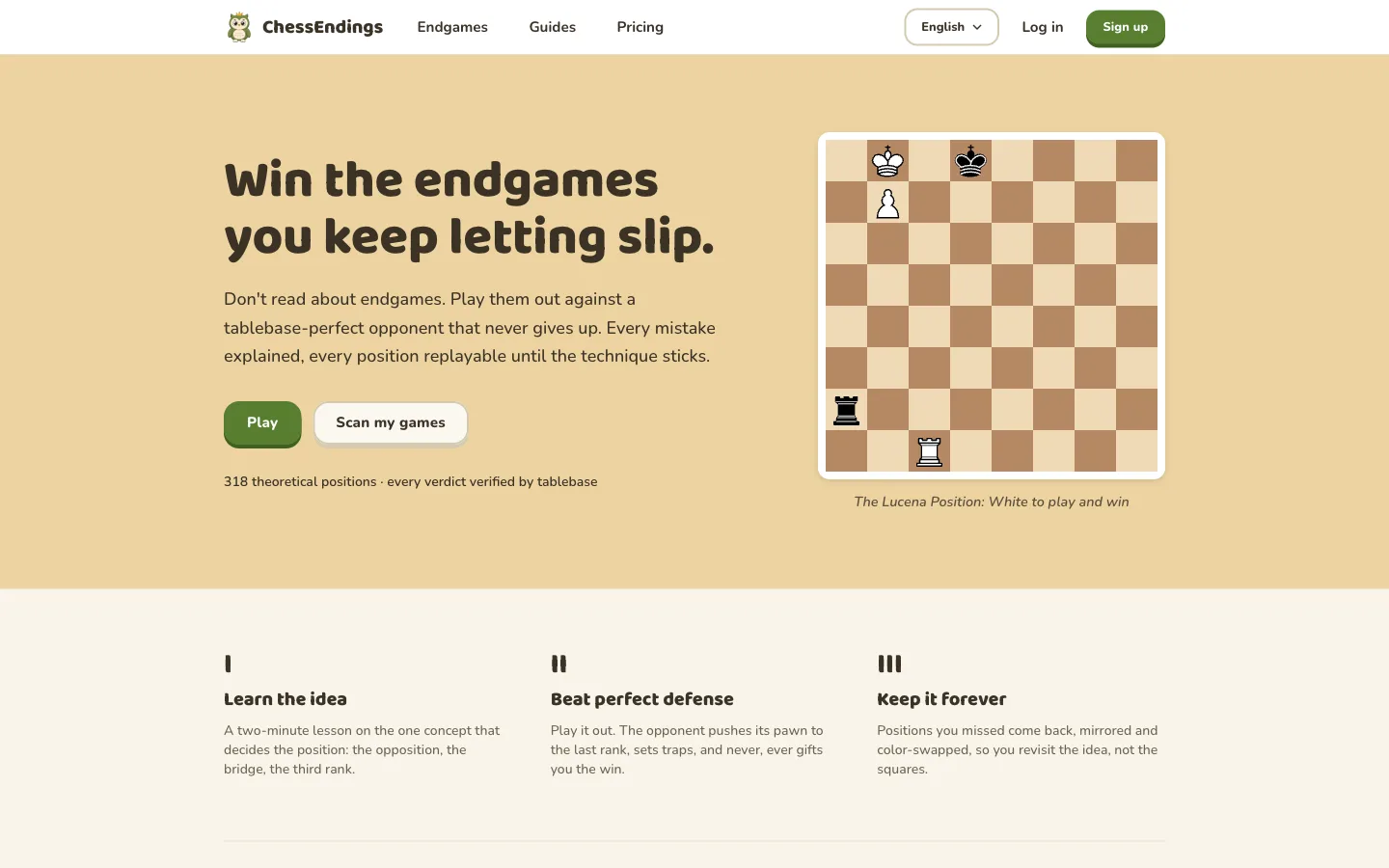
ChessEndings is built around playing a position all the way out. You play theoretical endings against an opponent that never gives up, with every mistake explained, and missed positions come back mirrored and color-swapped so you keep the idea rather than the squares.
Openings and visualization
For the other two pillars, the same small team builds ChessAtlas, a repertoire trainer with spaced repetition, and DarkSquares, a visualization and blindfold trainer.
Disclosure: ChessEndings, ChessAtlas and DarkSquares are built by the same team. The four tools compared above are not ours; we have described them from their own sites so you can compare and judge for yourself.